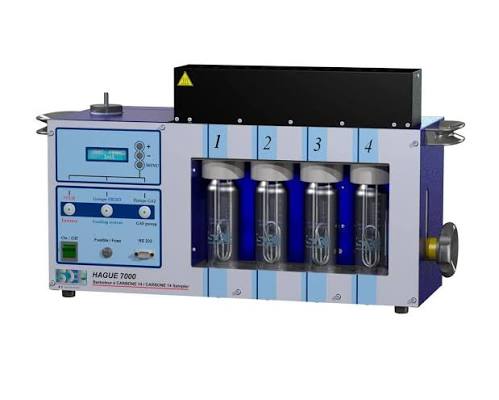
HAGUE-7000 aspirator (carbon-14 collector)
The HAGUE-7000 bubbler-based collection system is primarily used for detecting stack emissions and radioactive gases. The device is designed for optimal gas capture, featuring an ergonomic layout adaptable to a wide range of operating conditions. Liquid solutions can now be collected on a monthly basis—rather than the standard weekly interval—thanks to a water-cooling system that prevents fluid loss through evaporation. An innovative dynamic sealing system for the four collection flasks greatly simplifies device operation (start-up and shutdown) under any conditions, effectively preventing backflow or the loss of the solution.
A microprocessor manages all operational parameters, ensuring complete safety during long-term use.
Operating Principle
The radionuclide C-14 is captured via a bubbling process in a sodium hydroxide (soda) solution. C-14 present in the air may exist in the form of CO2, CO, or organic carbon. CO2 is captured directly in the first two flasks of the device. CO and organic carbon are oxidized in a furnace to produce CO2, which is then captured in the remaining two bubbling flasks.