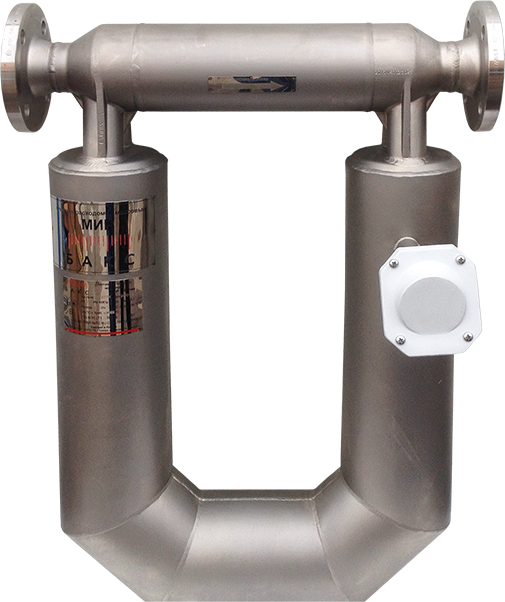
MIR Coriolis mass flowmeter
The MIR series Coriolis-type mass flow meter is a high-tech instrument designed for the direct, high-precision measurement of the mass flow rate of liquids, gases, and multiphase mixtures. Unlike traditional volumetric flow meters—which are dependent on pressure differentials or flow profiles—MIR series instruments determine the true mass of a substance, representing the gold standard for accuracy in the commercial and industrial metering of energy resources.
Purpose and Functionality
The primary function of the MIR flow meter is to provide continuous, real-time measurement of several critical flow parameters. A single unit simultaneously records:
Mass flow rate (with an accuracy of up to ±0.1%);
Fluid density (with high sensitivity to changes in composition);
Process temperature;
Calculated volumetric flow rate (derived from mass and density data).
This equipment is designed for use in the most demanding sectors, including the oil and gas industry, petrochemicals, power generation, and food production. MIR flow meters are highly effective for tasks such as dosing, loading/unloading, and product quality control; they are capable of handling everything from aggressive chemical reagents to viscous emulsions, suspensions, and cryogenic liquids.
Operating Principle
The device operates based on the Coriolis effect, which allows for the measurement of the mass of a moving fluid regardless of its electrical conductivity, pressure, or viscosity.
Inside the sensor, there are one or two specially shaped measuring tubes. An electromagnetic coil induces an oscillatory motion in these tubes at their natural resonant frequency. When there is no flow, the tubes oscillate in perfect synchronization. As soon as a liquid or gas begins to flow through the flowmeter, inertial forces—specifically Coriolis forces—act upon the flow. These forces exert resistance against the vibration of the flow tube: the tube’s motion is slowed at the inlet and accelerated at the outlet. This results in a microscopic "twisting" of the measuring system.
The device’s electronics monitor two key parameters:
Phase shift: The difference in signal transit time between the inlet and outlet detectors is directly proportional to the mass flow rate. The greater the mass of the substance flowing through, the more pronounced the twisting of the tubes.
Oscillation frequency: The density of the medium affects the vibration frequency of the tubes (much like how the sound of a string changes as its tension is adjusted). The denser the fluid, the lower the oscillation frequency.
Technological Advantages of the MIR Series Flowmeters
A defining feature of the flowmeters manufactured by NTF "BAKS" is their combination of exceptional precision and robust design. The flow path contains no moving mechanical components—such as impellers or pistons—which eliminates wear, the risk of jamming, and the need for frequent parts replacement.
MIR devices do not require straight pipe sections upstream or downstream of the installation point, which significantly simplifies their integration into existing process lines. Their explosion-proof design, wide operating temperature range, and resistance to vibration make them an optimal solution for demanding operational environments—supporting import-substitution initiatives while ensuring metrological stability throughout the entire calibration interval.